Latest insights
Top 5 Patio Cover Materials for Desert Climates

October 31, 2026
By D.A.D.S. Construction
Last Updated: October 31, 2026
Quick Summary
Aluminum with a powder-coated finish is the most common choice for desert patio cover materials because it resists UV fading, rust and insects with little upkeep. Wood needs regular sealing in strong sun, while vinyl, composite and polycarbonate options reduce maintenance further.
- Powder-coated aluminum resists UV fading and needs only an occasional wash.
- Wood covers need sealing or staining every one to two years in desert sun.
- Ask installers for the finish system, material gauge and wind load rating in writing.
- Solid roofs need ventilation, such as ridge or gable vents, to prevent heat buildup underneath.
- Shade sails are the lowest-cost option but need retensioning and eventual fabric replacement.
Table of Contents
- Why Material Choice Matters More in the Desert
- How We Compared the Five Materials
- Top 5 Patio Cover Materials at a Glance
- 1. Aluminum Patio Covers: Aluminum Patio Cover Pros and Cons
- 2. Wood Patio Covers and What Upkeep They Require
- 3. Vinyl Patio Covers and How Long They Last
- 4. Composite and Polycarbonate Covers for Heat and UV
- 5. Solid, Louvered, and Shade Sail Roof Options
- Choose the Right Cover for Your Desert Patio
- Frequently Asked Questions
Desert sun changes how a patio cover performs. In Southern Utah, summer temperatures routinely climb past 100°F, and UV exposure at elevation is intense. The material you choose determines how much shade you get, how it holds up, and how much upkeep it demands. This guide compares five common patio cover materials for desert conditions so you can match a material to your climate.
Why Material Choice Matters More in the Desert
Patio cover materials behave differently under heavy sun. Surface temperature, UV breakdown and thermal expansion all affect how long a cover lasts and how comfortable the space stays. A material that works well in a mild, humid climate can warp, fade or crack in dry heat.
The biggest mistake homeowners make is choosing on appearance alone. A cover that looks good on the showroom floor may fade within a few seasons if its finish cannot handle constant UV. Start with how the material handles heat and sunlight, then decide on style.
How We Compared the Five Materials
Most patio cover roundups list materials and call it a day. In the desert, that approach falls short because two covers that look identical on a spec sheet can perform very differently after five summers of 100°F-plus heat and intense UV. To make the comparison useful, we scored each material on the factors that actually drive desert performance, using a consistent 1-5 scale (5 = best) so the trade-offs are visible instead of buried in adjectives.
The scoring criteria:
- Heat reflection and surface temperature: How much solar gain the material absorbs and how hot the underside of the roof gets. Light-colored, reflective finishes and insulated roof panels reduce radiant heat; dark, uninsulated metal and solid panels run hotter.
- UV stability: How well the finish and the substrate resist fading, chalking, yellowing, and embrittlement under sustained UV. Powder-coated aluminum and UV-stabilized vinyl score well; unfinished wood and low-grade polycarbonate score poorly.
- Thermal expansion and contraction: Desert days swing from cool mornings to extreme afternoon heat, and the material has to move without cracking, oil-canning, or pulling fasteners. Metal expands more than wood or composite, which is why gauge, fastener type, and expansion gaps matter.
- Wind and dust performance: Resistance to uplift, panel flutter, and dust infiltration. Solid roofs and engineered aluminum systems handle wind loads better than fabric sails or thin panels; dust accumulation on textured or slatted roofs adds cleaning burden.
- Expected service life: A realistic range under desert exposure with normal maintenance, not a laboratory maximum.
- Maintenance burden: The annual hours and dollars required to keep the cover performing, sealing, painting, cleaning, retensioning, or replacing panels.
How the five materials score on desert performance (1-5, 5 = best):
| Material | Heat Reflection | UV Stability | Thermal Expansion | Wind/Dust | Service Life | Maintenance Burden |
|---|---|---|---|---|---|---|
| Aluminum (powder-coated) | 4 | 5 | 3 | 4 | 4 | 5 |
| Wood (sealed) | 3 | 2 | 4 | 4 | 2 | 2 |
| Vinyl (UV-stabilized) | 3 | 4 | 3 | 3 | 3 | 5 |
| Composite / Polycarbonate | 4 | 3 | 3 | 3 | 3 | 4 |
| Solid / Louvered / Shade Sail | 3-4 | 3 | 3 | 2-4 | 2-4 | 2-4 |
These scores are directional, not absolute. A high-gauge, insulated aluminum roof with a light reflective finish will outperform a budget aluminum panel on heat and wind; a cedar cover maintained on schedule will outlast an ignored softwood one. The point is to compare like with like and to weight the criteria that matter most for your site, full sun, wind exposure, dust, and how much upkeep you will realistically do.
Pricing depends on project size, design, attachment method, and current material costs, so request a written quote for your specific space.
Top 5 Patio Cover Materials at a Glance
Here is how the five materials compare on the factors that matter most in the desert:

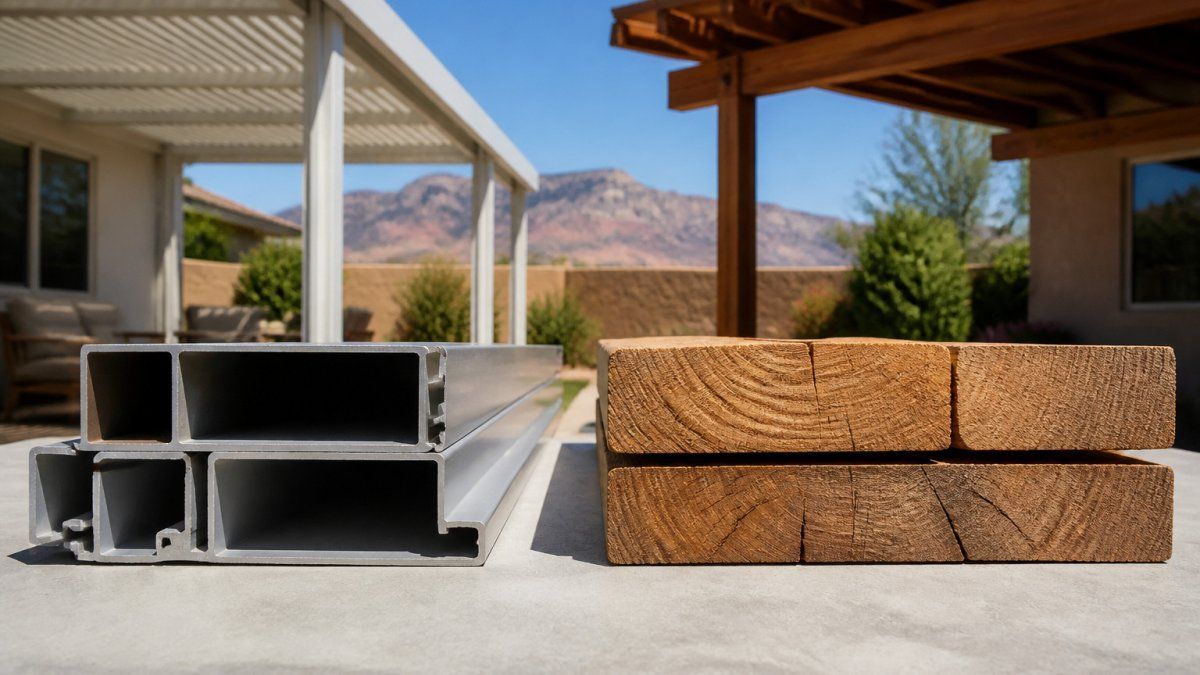
| Material | Heat and UV Handling | Maintenance | Upfront Cost Reference | Best For |
|---|---|---|---|---|
| Aluminum | Strong; powder-coated finishes resist fading | Low | Mid-range | Long-term, low-upkeep covers |
| Wood | Good shade; needs regular sealing | High | Mid-to-high range | Natural look and warmth |
| Vinyl | Resists UV; can soften in extreme heat | Low | Varies by design | Hands-off maintenance |
| Composite / Polycarbonate | Strong UV filtering; can yellow over time | Low to moderate | Varies by design | Maximum UV blocking |
| Solid, Louvered, or Shade Sail | Depends on roof design | Varies | Shade sails are the lowest-cost fabric option | Adjustable shade and airflow |
Use this table as a starting point. The right choice depends on how much maintenance you will do and how much shade you need.
1. Aluminum Patio Covers: Aluminum Patio Cover Pros and Cons
Aluminum is a common choice for desert patio covers. It does not rot, it resists insects, and a quality powder-coated finish holds its color under strong sun. Aluminum suits homeowners who want a cover that needs little attention once installed.
Pros:
- Resists rust, rot and insect damage
- Powder-coated finishes hold color better than unfinished metal
- Low maintenance: an occasional wash is usually enough
- Available in solid, lattice and insulated designs
Cons:
- Metal can get hot to the touch in direct sun
- Lower-gauge aluminum can flex or dent under heavy wind or hail
- Solid aluminum roofs can feel less natural than wood
Pay attention to material thickness and finish quality. Ask any installer for the gauge and finish specification in writing. If you want to compare a related structure, you can explore adjustable pergola designs.
2. Wood Patio Covers and What Upkeep They Require
Wood gives a patio a warm, natural look that many homeowners prefer. The trade-off is maintenance. Desert sun dries out wood, causing it to check, split and gray if it is not protected.
Pros:
- Natural appearance and warmth
- Good shade from solid or slatted designs
- Can be stained or painted to match the home
Cons:
- Requires regular sealing or staining to resist UV damage
- Can crack and split as it dries out in low humidity
- Needs periodic inspection for insects and loose fasteners
A practical maintenance routine: inspect the wood each spring, clean it, and reapply a UV-protective sealer or stain every one to two years. If you are also weighing wood outdoor structures, you can review deck construction options. Skipping this schedule is the most common reason wood covers deteriorate early. Reclaimed or naturally resistant woods such as cedar hold up better than standard softwoods, but they still need protection in strong sun.
3. Vinyl Patio Covers and How Long They Last
Vinyl is a low-maintenance option that resists UV fading better than many homeowners expect. It does not need painting or sealing, and it can be cleaned with a hose and mild soap.
Pros:
- Minimal maintenance; no painting or staining
- Resists UV-related fading when the material is quality-grade
- Clean, uniform appearance
Cons:
- Lower-grade vinyl can soften, warp or sag in prolonged extreme heat
- Limited design variety compared with aluminum or wood
- Quality varies widely between manufacturers
Lifespan depends heavily on the grade of vinyl and how it is installed. Ask for UV-stabilized, heat-rated material and confirm the manufacturer's warranty terms before you buy. Heavier-gauge vinyl handles desert temperatures better than thin, budget panels.
4. Composite and Polycarbonate Covers for Heat and UV
Polycarbonate and composite panels are designed to filter sunlight while still letting in light. They are a strong choice when UV blocking is the top priority.
Pros:
- Strong UV filtering for protecting furniture and flooring
- Lightweight, with good impact resistance
- Lets in diffused light, reducing harsh glare
Cons:
- Some panels can yellow or cloud over time if the UV coating is weak
- Heat can build under solid panels without adequate ventilation
- Design options can be more limited than with aluminum
Look for panels with a UV-protective coating and confirm the warranty covers yellowing. Good ventilation under the cover helps reduce heat buildup, which matters a great deal in the desert.
5. Solid, Louvered, and Shade Sail Roof Options
The roof style matters as much as the material.
Solid roofs: A solid roof, aluminum, composite, or polycarbonate panels, provides the most complete overhead shade and the best protection from direct sun, rain, and dust.
Louvered roofs: Adjustable aluminum louvers let you open or close the slats to balance shade and airflow. In the desert this adjustability is genuinely useful, full shade and restricted airflow in July, open slats for breeze and winter sun in January.
Shade sails: Fabric sails are the lowest-cost entry point for shade. Sails provide flexible shade and let hot air escape, but they offer less protection from wind-driven dust and heavy UV than a solid roof, and the fabric needs retensioning and eventual replacement.
Choosing by use case:
- Maximum shade and rain protection: Solid insulated aluminum roof with ventilation.
- Adjustable comfort and airflow: Louvered aluminum roof.
- Lowest upfront cost and flexible shade: Shade sail, with realistic expectations about wind and fabric life.
- Maximum UV blocking for furniture and flooring: Solid polycarbonate or composite panels with a UV-protective coating and good ventilation.
For a shaded, ventilated patio in a hot climate, a louvered or solid aluminum roof usually delivers the best combination of comfort and durability. The right choice depends on how much shade you need, how much wind your site sees, and how much maintenance you are willing to take on.
Choose the Right Cover for Your Desert Patio
The right patio cover material balances heat and UV performance, upkeep and budget. Aluminum is our top recommendation for most desert homeowners because it combines durability with low maintenance. Wood offers warmth but requires regular sealing. Vinyl and composite options can reduce upkeep, and shade sails give the most affordable entry point.
Frequently Asked Questions
What type of roof is best for a patio cover in the desert?
A solid roof gives the most consistent shade and blocks the most UV, which is why many desert homeowners choose it. Insulated aluminum panels and solid composite roofs are common choices. Lattice and shade sail designs let more light and heat through, so they suit areas where some sun is welcome. The best roof depends on how much shade you want, your budget, and how much maintenance you are willing to do. Confirm material thickness and panel rating with your installer before you commit.
How long do vinyl patio covers last in desert heat?
Vinyl holds up well against UV and does not rust, but intense desert sun can cause some fading and brittleness over many years. Quality, UV-stabilized vinyl generally performs better than thin, unrated products. Lifespan depends on panel thickness, installation quality, and how much direct sun the cover receives. Ask your contractor for the manufacturer's warranty and product specifications so you can compare lifespan claims directly.
Is aluminum or wood better for a patio cover in a hot, dry climate?
Aluminum generally requires less maintenance and resists warping and rot, which makes it a practical choice in dry heat. Wood offers a natural look, but it needs regular sealing or staining to protect it from sun and dryness. Wood can be a good fit if you are willing to maintain it on a schedule. Aluminum is usually the lower-maintenance option, while wood suits buyers who value appearance and accept more upkeep.
Do patio cover materials need special maintenance in a desert climate?
Yes. Intense UV exposure, dust, and temperature swings all affect patio covers. Wood typically needs periodic sealing or staining, and finishes should be checked each year. Aluminum and vinyl need less upkeep but benefit from occasional cleaning to remove dust and debris. Inspect fasteners, gutters, and seals on any material, and address small issues before they grow into larger repairs.
D.A.D.S. Construction has over 30 years of veteran-owned experience building custom patio covers, pergolas, sunrooms and home additions across Southern Utah. Contact us today to talk through your materials, roof style and budget, and get a clear plan for shade that lasts in the desert sun.
GARAGE DOOR INSIGHTS
More from Liftworks Overhead Door Services